In early September I was on a short tourist visit to picturesque Guilin, in China’s Southwestern Guangxi Zhuang Autonomous Region, where I had come out after a business trip to Hong Kong. It turned out the film ONCE UPON A TIME IN THE MIDDLE EAST was playing at the nearby cinema. I was naturally curious about it: I had already heard that it was the biggest summer hit in China, that it had invariably stayed on top of box office charts for several weeks, and that its global ratings resembled those of THE ODYSSEY (which also played well, but to lesser audiences). I thought I must make sure to go see it.
Whilst reviewers in the West were still to register its existence (especially as the film has not been entered at any international film festivals), I noticed there were active threads on Reddit and Letterboxed already — and many were praising it. So I felt I wanted to seize the opportunity and see it. This turned out to be possible as all blockbuster-type films in China are usually distributed with two sets of subtitles, in Chinese and in English. It was the same case with the screening at the IMAX screen in Guilin where we went to see it, even if I were perhaps the only person in the hall who needed the English subtitles.*
Since the time I saw it, ONCE UPON A TIME IN THE MIDDLE EAST has opened to great acclaim in Australia, Japan and North America; it was announced it has been purchased for distribution in the UK. It is still in the top five of China’s box office charts. Last week, it was officially announced that it has been chosen to be China’s entry for the foreign language Oscar.
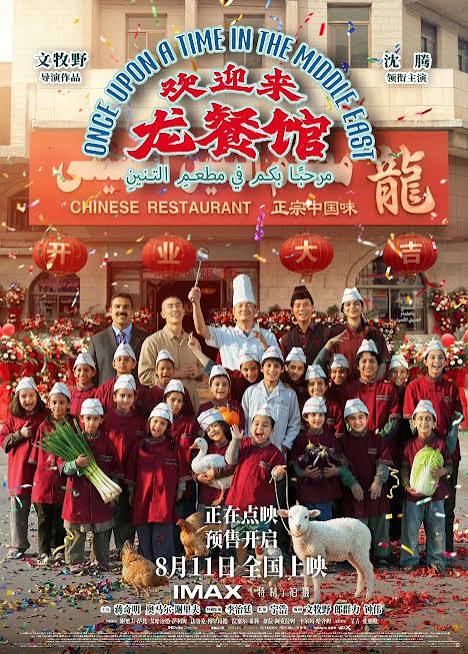
Well deserved. The film is a natural blockbuster. A culinary angle always works. And even if one can describe it as film ‘propaganda’ which puts forward state-sponsored narrative lines, it is likely to be a) extremely profitable, and, b) seriously impactful, especially because of its anti-war message.
Let me look at both statements. First, in terms of profitability. Having been made for about $46 million and with an extra $38 million marketing costs ($84 million in total), the film had broken even on the Chinese market even before the end of summer. It is early days of its international exposure, yet the worldwide gross stands at some $366 million already. This is a performance which Hollywood blockbusters strive for — first recoup production and marketing costs at home and then ensure profitability in international markets. Chinese films rely especially on markets with large diasporic audiences, and those are found not only in the Americas, Australia, and Europe, but increasingly also around Asia and Africa.
Second, the film is already extremely successful with audiences. IMDb ratings give it 8.3 (out of 10). Those writing on IMDb, Reddit and Letterbox note that whilst they expected it would be a propaganda film (and felt it was such for the the first part), progressing through the film offered surprising reversals that kept them thoroughly engaged and ultimately left them with a satisfying anti-war redemption. It had shown how everybody engaged in an international conflict has a side that is violent and corrupt, which finds expression in narrow-mindedness and inability to empathise. In a context where there are no good guys, the only one who remains consistently humane is the protagonist — a simple Chinese cook who has come to the Middle East to earn money — who starts as an innocuous simpleton but gradually grows into a resilient hero who takes care of young orphans and rescues lives in situations where his own hangs on a thread.
ONCE UPON A TIME IN THE MIDDLE EAST falls roughly into two narrative segments which, even if ensuing from one another, are starkly different (and this is perhaps the best quality of the highly original script). Whereas the first part, which depicts an unjustified Western assault on the unnamed Middle Eastern country, where the protagonist has found himself after taking a cook’s position in an ethnic Chinese restaurant, could be seen as fairly stereotypical, the second one, where he becomes a witness to the twisted extremism of radical Islamists who would send children to death in pursuit of their fanatic causes, takes the story into a direction that is unexpected and redeeming.
Having agreed to cook in (supposedly) Iraq for a term that would allow him to repay his debt before rushing back home to his daughter and elderly mother, Xu Fu’s situation drastically changes after the bombs start falling. Having bonded with his Arab boss (a ministry employee) and his Chinese colleague, and having put the Lucky Dragon restaurant back on its feet, he embraces the children from the local orphanage by giving them shelter and training one of them into the subtleties of Chinese cooking. Over time, he witnesses (and himself experiences) various injustices and sees how people are being blackmailed by profiteers. No wonder so many turn into hardened combatants. Xu Fu supports the resistance, even if strictly in his capacity of a cook. He wants to counter the devastating impact of the war on local people by giving them little (culinary) joy.
But it does not stop at that. Whilst in the first part it is the western powers who inflict disarray and exploit the residents, in the second part the focus shifts on to the terror inflicted on locals by their own radicalised faithful, who, having seen loved ones perish have lost their capacity for compassion. Xu Fu and the orphans think they are on the run toward freedom, but in fact they find themselves trapped in a new horrible ordeal, inflicted on them by people who were just ordinary family men until a few months earlier but who have now transformed into crazed assassins. Even in this new treacherous situation, however, Xu Fu finds a way — with his cooking and emotive diplomacy skills — to save most of the children and finally return home, but not before losing some of his dearest on the way.
In an intensely sentimental epilogue, Xu Fu returns to the Lucky Dragon restaurant two decades later to discover that the menu features a signature dish named after him. And that the owner is Zaid, the orphan who he taught how to cook but whom he believed to have lost in the last skirmish. Xu Fu tucks in, relieved.
This is the third feature of 41 year-old director Wen Muye, whose debut work, DYING TO SURVIVE (2018), was also a blockbuster. Both the acting and the technical achievements (the so-called ‘production value’) of the film are quite high. It is dynamically paced and it perfectly fits into the action-adventure genre, even if one may classify it also as an anti-war thriller. The main role is entrusted to Shen Teng, an acclaimed comedian. The participation of 16 year old Egyptian adolescent Omar Sherif is also noteworthy, along with other performances.
Someone had remarked that ONCE UPON A TIME IN THE MIDDLE EAST seems to depict how China wants to position itself on the international scene: As a bystander who is prepared to dodge bullets just to earn a buck. Ready to give a hand out of sheer empathy, but not wanting to act as the world’s policeman. While others around Xu Fu were seen going berserk and engaging in mindless violence, the Chinese man manoeuvred his way smartly and only took sides where outrageous injustices were being committed. On the whole, he managed to stay cool and pursue his own agenda, cooking and feeding people, no matter what.
I generally agree with this take.
*such subtitling policy makes it easier for English speakers to see a Chinese film in China rather than an Italian film in Italy or a French film in France as well as in most countries of the European Union, as they traditionally do not provide any foreign language subtitling for the national films.