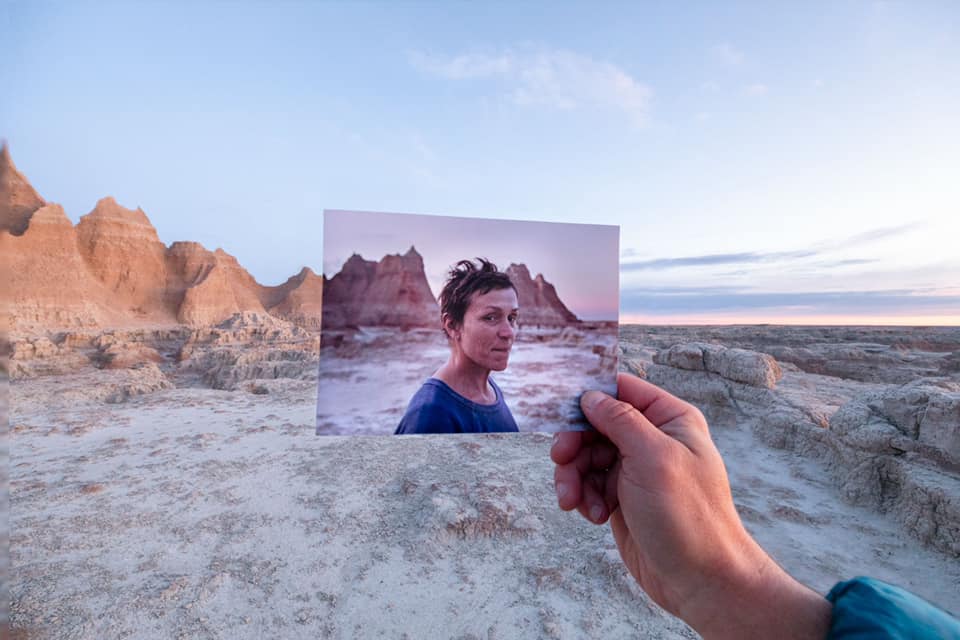
Watched NOMADLAND (2020) and even if l was not particularly taken by it, l find myself thinking of it, so let’s share.
First, this is a Buddhist film which quietly asserts liberating oneself from formalised social structures and celebrates ‘living in the now’, and in that l appreciate its message. It is yet another film in the long tradition of road (or, better, ‘roaming’) movies, in this instance filmed with a filter that gives it a dusty blueish hue in embracing the majestic beauty of Mid- and South West expansive landscapes. It made me think of films such as INTO THE WILD (2007) and WILD (2014), but its documentary aesthetics and implicit critique of neoliberal capitalism also brought to mind films such as MANUFACTURED LANDSCAPES (2006) and AMERICAN FACTORY (2019).
The nomad protagonists of the film — most of who play themselves — may have been pushed into their peripatetic lifestyle by the vissisitudes of predatory capitalism but have now unreservedly embraced the itinerant lifestyle. They can no longer be confined; they no longer feel well under a solid roof and do not care for fresh linen, scented soaps or candles.
At one point — while dancing in a pub — one of them exclaims, ‘we are American Gypsies.’ And indeed they are — having seen dozens of films about true Gypsies (or Romanies, as one should call them) l can confirm that a lot of what l see in NOMADLAND are the same key motives of Roma-themed films: rejection of conformism, living outside rigid social structures, drifting…
But in here also lies my problem with NOMADLAND. It is a film about white people* that have turned Gypsies (implying they would not normally do so), about characters who continue pondering — even with a progressively lessening attachment — over a possible return to a settled lifestyle behind a white picket fence. The unspoken norm is that even if they now embrace the wayfarer lifestyle they would not have normally chosen it, they have been pushed into it.
I have not seen the other films of Chloe Zhao, so this is my first exposure to her work. I notice that everywhere she is listed as Chinese (not even Chinese-American) even though she does not seem to have lived in China since she was a teenager, and all of her education and work is in the West. In this vein, I am intrigued — in the case of NOMADLAND — by the politics of awards (a sphere in which l like to exercise scrutiny).
The film received the top award at the Venice Film Festival in 2020 — the only festival that managed to take place live even if in a paired-down format. Venice is notorious for its traditional exclusion of women who, according to their selectors, do not seem to have delivered good work over the years — yet in 2020 Venice IFF made a big push to redeem themselves and had over 40% of films in competition directed by women. This is the first time ever that the Golden Lion went to a female director, and it is even a more progressive sign that the director is Chinese and not a Westerner.
Next we see the film nominated in the Golden Globes, and there is talk it is a candidate for a top Oscar. I think there is a fair chance for this film to win, what precisely l cannot say. Indeed, a win for NOMADLAND would tick many of the right boxes, namely: A. It will be a triumph of indie Sundance aesthetics at the Academy (and, for my pleasure, it would mark an extreme departure from celebrated syrupy abominations of the type of LA LA LAND). B. Awarding Chloe Zhao would show open-mindedness, would empower female directors, and it would give a nod to Chinese creativity, a gesture that is important for the film industry in a context where China is Hollywood’s most important market whilst the new Biden administration is positioning to continuing the trade war.
I understand it was Frances McDormand who read the book by Jessica Bruder on which the film is based, then optioned it, then approached the director and pulled off the production in which she then starred. Here we go: a 63 year old actress triumphs in a role that gives her plenty of screen time and leads to well-deserved recognition. I like this creative model, as it may be one of the few approaches available to women to counter ageism: taking matters in one’s own hands.
Ah, and l nearly forgot. David Strathairn, the only other actor in the film. I think of this man — a self-deprecating professional with a long list if supporting roles to his name and a few main roles as notable exceptions — as the best looking American actor, actually.
And OMG what a white film that is. Not only were the nomads in the film all white but they did not even seem to cross paths with any Native Americans nor any other ‘others’. In my memory travelling through these same states was an experience full of encounters with people of many different backgrounds and skin tones. Even the Proud Boys are more ethnically diverse. If it was not for its Chinese director and its socially engaged theme, it would make for a prime candidate for critique on ignoring racial divides.